What a short video can reveal
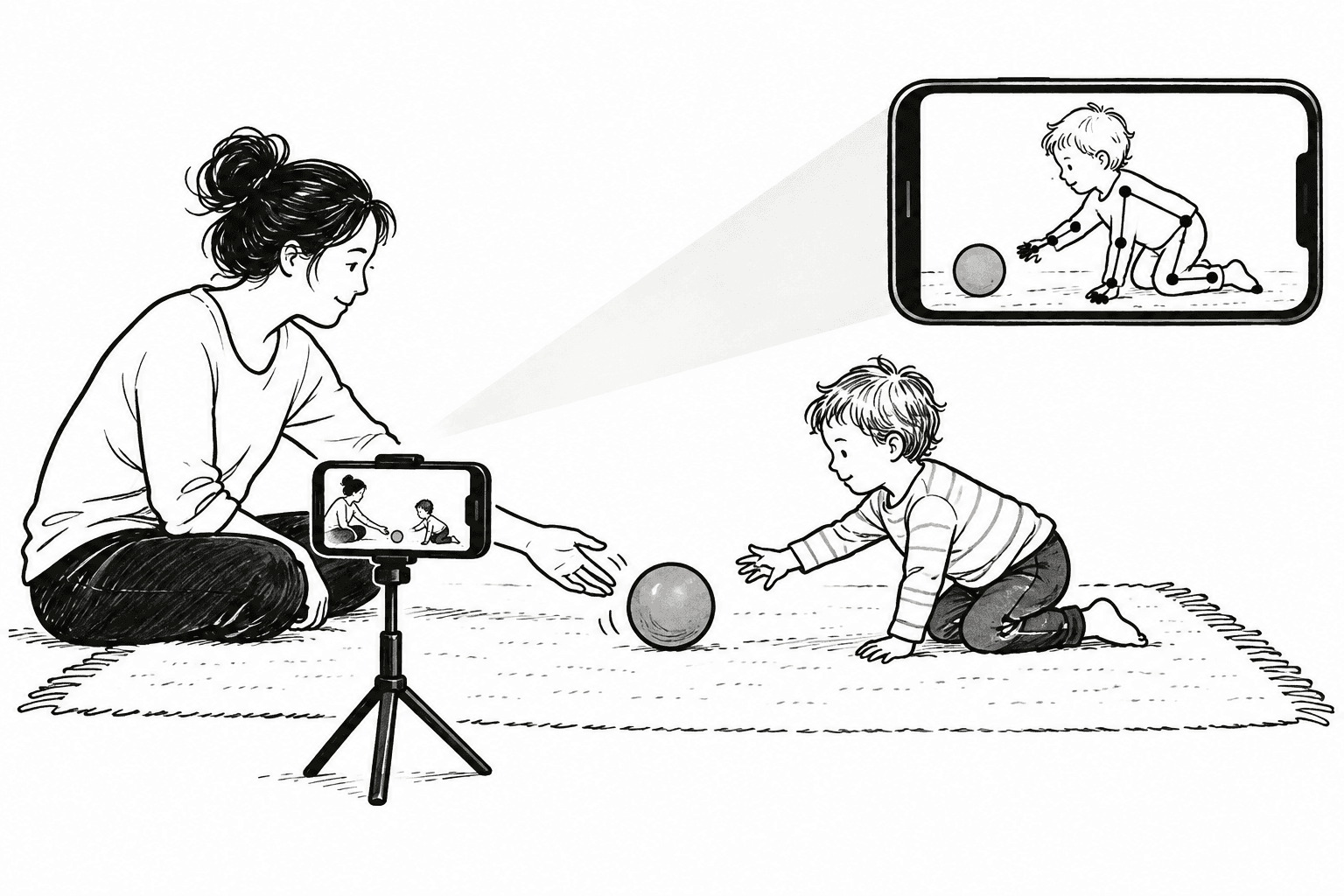
A parent calls a child's name, demonstrates a movement, or rolls a ball. These brief exchanges are the starting point for a study from South Korea. Rather than asking a family to record a long assessment, the researchers designed three video tasks, each lasting less than a minute, to capture aspects of social interaction at home. [1]
The researchers trained models to distinguish recordings from children with an autism diagnosis and children described as typically developing. The combined model found a signal in these interactions, but it also made mistakes. The intended role is screening: helping identify who may need a closer assessment, rather than making a diagnosis from a video. [1]
Recording at home could make it easier to gather information before a specialist visit. The question is whether those recordings can help families get useful support sooner. This study tested how well the model distinguished the two groups; it did not measure shorter waiting times or better outcomes for children. [1]
What the videos capture
Responding to a name
The timing of a child's response when a parent calls.
Copying a movement
How the child imitates an action shown by a parent.
Playing with a ball
Patterns of turn-taking during a shared activity.
Study tasks, not a home diagnostic checklist. [1]
Where AI does the work
Turning a recording into useful observations normally takes someone watching and interpreting it. Here, deep-learning models extract measurable features from video and audio, such as the timing of a response or patterns of movement. Other machine-learning models combine those features with age and sex to produce a prediction. [1]
A recording becomes a set of measurements: how long a response takes, how a movement is copied, or how a ball moves between people. The model compares these measurements with patterns learned from the study data. [1]
The researchers combined predictions from the available tasks rather than relying on one behavior alone. Not every child had all three recordings. That matters because the system did not receive the same set of observations for every child. [1]
A useful signal, with room for error
Table 2 reports two different measures for the combined model. Accuracy describes how often a classification matched the study label. AUROC describes how well the scores separated the two groups across different decision cutoffs. Neither number tells a parent the probability that their child has autism. [1]
75% accuracy
Reported mean, with a standard deviation of 2 percentage points. This is not a guaranteed result for new families.
0.83 AUROC
Reported mean, with a standard deviation of 0.01. A separation score, not 83% accuracy.
The methods describe using 80% of the data for training and model selection, with 20% held back for testing. Testing on withheld data is useful, but it is different from another team evaluating the system with new families. The table reports means and standard deviations, not a count of correct diagnoses in routine care. [1]
The results describe 90 children in the test dataset. Some supplied more than one task video, giving 104 test recordings. This is why the number of videos is not the same as the number of children assessed. [1]
Who might the study be missing?
The comparison included children with autism and children described as typically developing. It did not represent the full range of children who might come for an assessment, including those with language delays or other developmental differences. Most participants were boys, and the children were under four years old. These limits make it harder to know how the tool would perform in everyday care. [1]
The model also missed some children whose autism-related differences were less pronounced. A reassuring score therefore cannot establish that a child does not need support. The group without an autism diagnosis was not followed over time, so the study could not check whether their diagnoses later changed. [1]
The next useful evidence would come from testing with a wider range of children and following what happens after screening: who receives further assessment, which children are missed, and whether families reach appropriate support sooner.
Sources & context
One original study. The publisher and full-text archive below contain the same paper, not independent confirmations.
Automated AI based identification of autism spectrum disorder from home videos
Kim and colleagues · npj Digital Medicine · October 10, 2025