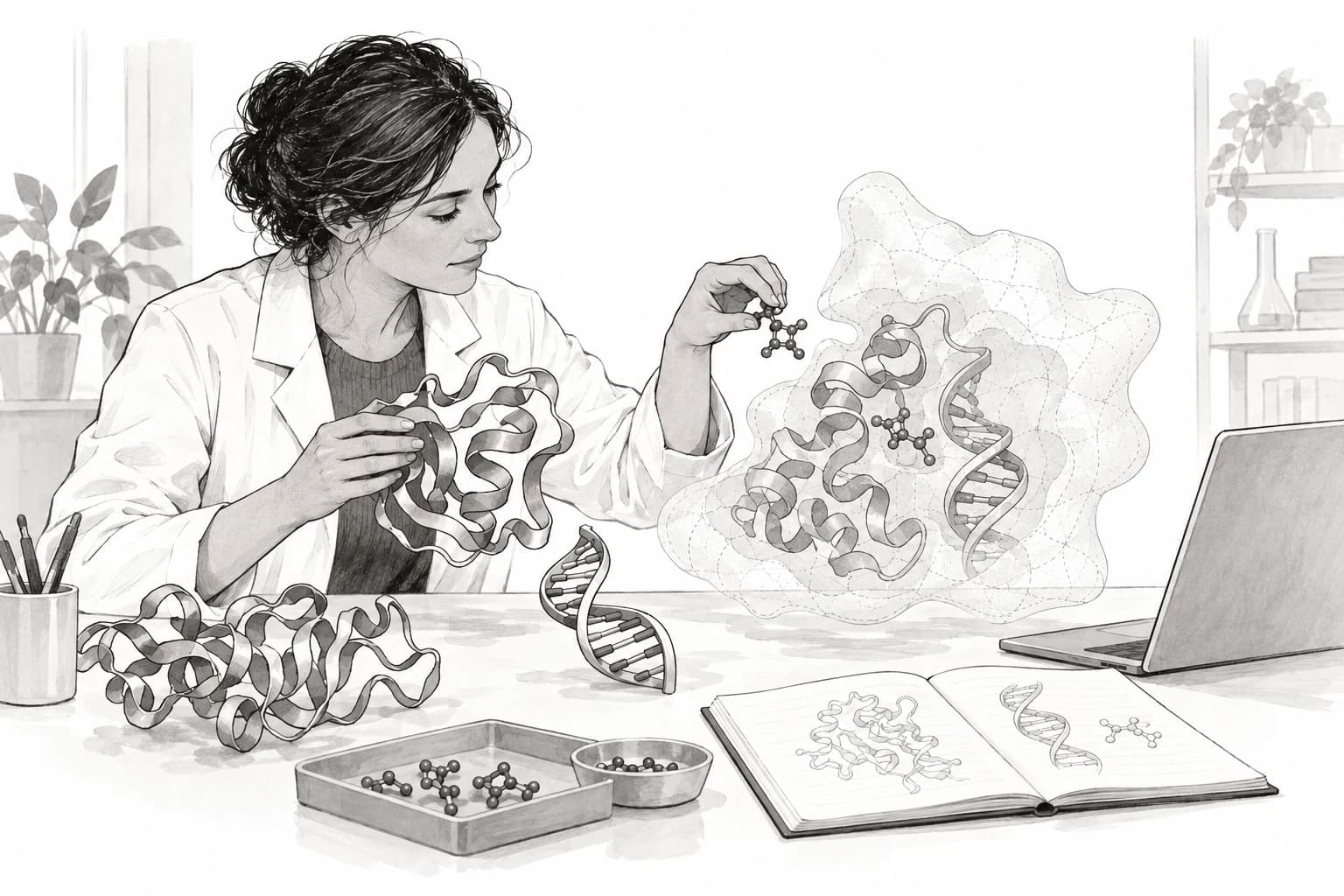
Biology happens through interactions
A protein rarely acts alone. It may bind DNA, RNA, another protein, an ion or a small molecule. Learning the shape of the whole complex can help researchers form hypotheses about how a cell works or where a drug might bind. [1]
AlphaFold 3 uses one model to predict the joint atomic arrangement of many of these molecular types. A diffusion process starts from a disordered set of coordinates and repeatedly adjusts them toward a proposed three-dimensional structure. [1]
Broader and often more accurate
The authors evaluated the model on held-out structures and newer structures deposited after its training cutoff. It outperformed several specialist methods for protein interactions with ligands, nucleic acids and antibodies, although performance varied by interaction type. [1]
The reported score usually comes from the model's highest-confidence prediction among several attempts. That is useful for research triage, but it is not the same as knowing the structure before an experiment. [1]
Prediction still needs physical evidence
The model can produce chemically implausible details and sometimes gives high confidence to an incorrect arrangement. Accuracy also falls for some underrepresented molecules and interactions. [1]
A structure prediction does not establish that two molecules bind in a living cell, that a compound is safe or that it treats disease. Those questions still require experiments. The paper was produced largely by Google DeepMind and Isomorphic Labs researchers, organizations developing related products. [1]
Sources & context
One model paper with multiple benchmark datasets, not independent replications.
Accurate structure prediction of biomolecular interactions with AlphaFold 3
Abramson and colleagues · Nature · May 8, 2024